
Visual Search for Indian E-commerce: When Words Fall Short
How image-led search helps buyers find products they can see but cannot name
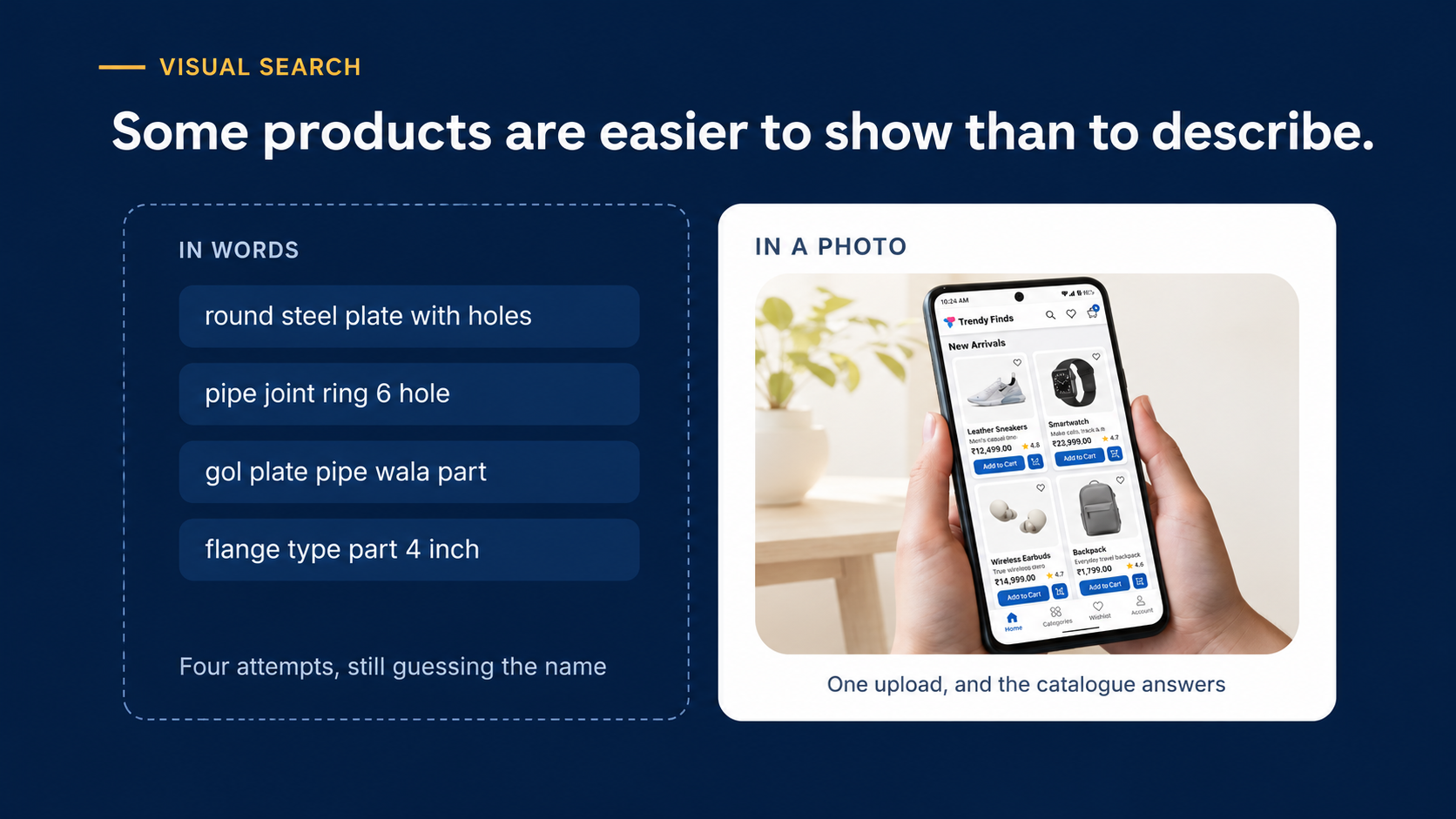
A buyer on an Indian marketplace often knows exactly what they want. It is in their hand, on a shop shelf, or in a photo a colleague forwarded. What they lack is the word the seller used to list it. Text search asks them to guess that word. Visual search lets them skip the guess.
The vocabulary gap
Every catalogue has its own language. Sellers write titles in trade terms, model numbers and whatever keywords they believe will rank. Buyers describe what they see: a colour, a shape, a rough purpose, often in Hinglish or a regional language written in Roman script.
The distance between those two vocabularies is where searches fail. The product exists and the buyer wants it, yet the query and the listing never meet. The buyer tries a second phrasing, then a third, and then leaves. For the platform, that is a lost transaction for a product it had in stock.
The problem is sharpest where products resist description. Industrial parts, fabric prints, furniture styles and jewellery designs are easy to recognise and hard to put into words. In these categories a photo carries more information than any query a buyer is likely to type.
Why a clean demo is not the test
Visual search is easy to demonstrate and hard to run. Most demos match one studio photograph to another: white background, even lighting, the product centred. Real buyers do not send studio photographs. Their images tend to fail in four ways:
- Poor lighting. A part photographed on a workshop floor, or a fabric under a tube light that shifts its colour.
- Partial framing. Half the object is outside the picture, or a hand covers part of it.
- Clutter. The product sits among other objects, and the system has to decide which one the buyer means.
- Second-hand images. A screenshot from a chat, cropped and compressed more than once.
A system tuned only on catalogue imagery will perform well in review and poorly in production. The useful question to ask of any visual search product is what kind of photographs it was tested on.
What production visual search needs
Those failures define the requirements. This is the design behind KnowDis Lens, our visual search product:
- Search by image, by text, or by both. A buyer can upload a photo or paste an image URL, and add words to refine it: “this, but in red”. The image says what the product is; the words say what should change.
- Ranking that reflects the business. Visual similarity alone is not a result. Lens applies personalised, business-aware ranking, so what appears first is both a close match and something the platform wants to surface.
- Trained on Indian catalogues. The models are trained on Indian fashion and lifestyle catalogues, where the products, prints and styles differ from those in most public datasets.
- Proven at scale. We run visual search in production for IndiaMART, across tens of millions of SKUs, on the imperfect imagery described above.
What changes day to day
For the buyer, the search starts from what they already have. One upload replaces several attempts at phrasing, and a few added words narrow the results the way a conversation with a shopkeeper would.
For the seller, a listing can be found even when its title uses different words from the buyer's. A good product photograph becomes a route to discovery, not only a decoration on the page.
For the platform, fewer searches end with no useful result. Visual search does not replace text search. It covers the cases text search handles worst, and the two work better together than either does alone.
See it on your own catalogue
KnowDis Lens is built by KnowDis AI, the New Delhi team behind AI search and language systems serving some of India's largest e-commerce platforms. To see Lens search your own catalogue, try the demo at lens.knowdis.ai, book a call, or write to us at info@knowdis.ai.