
Visual Search in Production: Five Questions Every E-commerce Leader Should Ask
What separates a convincing demo from a system that earns its place on your platform
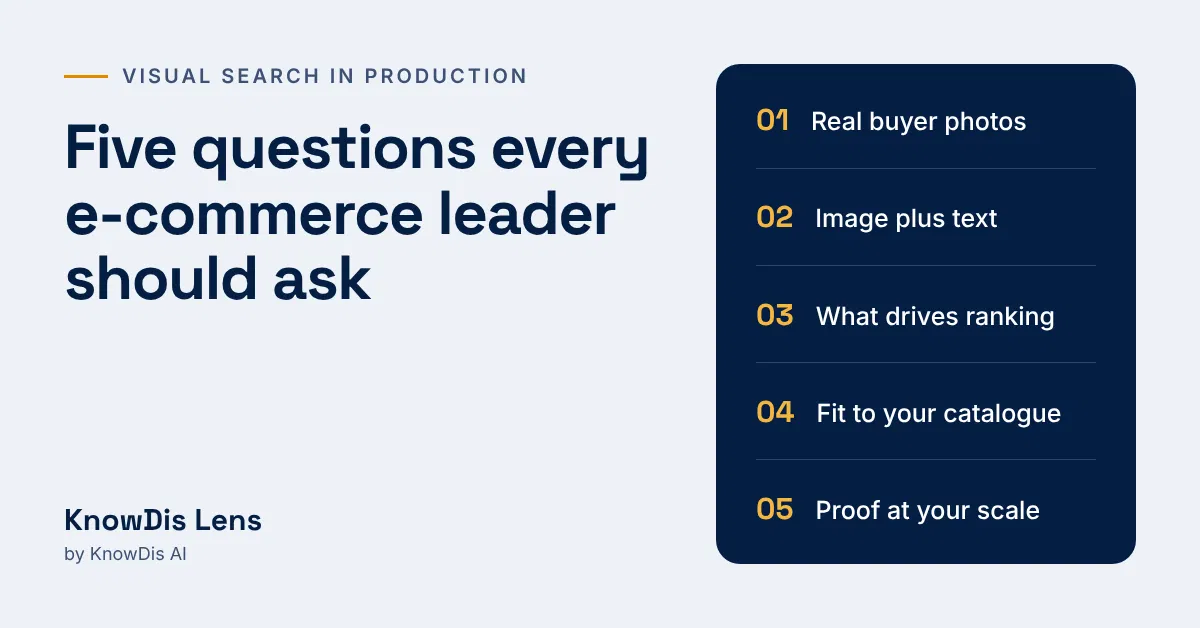
Every visual search product looks good in a demo. A clean product photo goes in, a row of near-identical products comes out. The differences that matter appear later, in production, with real buyers and a real catalogue. These five questions bring those differences forward to the evaluation stage.
1. What photographs was it tested on?
Ask to see results on images your buyers would actually send, not on catalogue shots. Bring your own test set: photos taken on a phone in poor light, objects partly out of frame, products sitting among other things, screenshots forwarded from a chat.
Matching one studio photograph to another is the easy case. If a vendor's examples all have white backgrounds, you have learned how the system behaves on a problem your buyers do not have.
2. Can the buyer add words to the image?
A photo says what the product is. It cannot say what the buyer wants changed. Someone who uploads a picture of a blue kurta may want that kurta, or the same cut in red, or the same print in cotton.
Image-only search forces them to accept whatever looks closest. Search that combines image and text lets them say "this, but in red" and narrows the results accordingly. Ask whether the two inputs are genuinely combined in one query, or whether text is applied afterwards as a filter on image results. The second approach breaks as soon as the attribute is missing from a listing.
3. What decides the order of results?
Visual similarity produces candidates. It does not produce a ranking your business can live with. The closest visual match may be out of stock, from a seller who does not ship to the buyer, or priced far outside what this buyer usually considers.
Ask how business signals enter the ranking: availability, seller quality, margin, the buyer's own history. Ask also who controls those signals. A system whose ranking you cannot influence will optimise for resemblance alone, and resemblance is not the same as a sale.
4. Does it know your kind of catalogue?
A model trained on global fashion imagery has seen few sarees, lehengas or kurtas, and fewer still of the prints and weaves that distinguish one from another. It will treat products as similar that any Indian shopper would tell apart at a glance.
Ask what the models were trained on, and whether that data resembles your categories. The same applies outside fashion: industrial parts, home goods and jewellery each have distinctions that a general-purpose model tends to miss.
5. Has it run at your scale?
A search that works on a hundred thousand products can behave very differently on fifty million. Latency rises, near-duplicates crowd the results, and the long tail of rarely viewed listings becomes most of the catalogue.
Ask for a production reference at a catalogue size close to yours, and ask how long that deployment has been live. A pilot is evidence that something can work. Production is evidence that it does.
How KnowDis Lens answers them
We built KnowDis Lens with these questions in mind, and we are happy to be asked them.
| Question | KnowDis Lens |
|---|---|
| Tested on real photographs? | Runs on the imperfect imagery real buyers upload, not only catalogue shots |
| Image and text together? | Search by image, by text, by photo URL, or by image and text combined |
| What decides ranking? | Personalised, business-aware ranking on top of visual similarity |
| Knows the catalogue? | Trained on Indian fashion and lifestyle catalogues |
| Proven at scale? | In production for IndiaMART, across tens of millions of SKUs |
The best way to evaluate any of this is on your own data. Try the demo at lens.knowdis.ai, book a call, or write to us at info@knowdis.ai, and bring your hardest photos.